Node.js 26.4.0 Makes Package Resolution a Runtime Feature, Not Just a Package Manager Trick
Node.js 26.4.0 quietly adds experimental package maps, pushing dependency resolution closer to the runtime and making monorepo mistakes harder to hide.

Node.js 26.4.0 is more important than a normal point release
On **June 24, 2026**, Node.js shipped `v26.4.0`. If you skimmed the release notes, it looked like a standard Current release with a handful of semver-minor additions. I think that undersells it.
The interesting part is not one shiny API. It is that Node is starting to absorb concerns that used to live entirely in package managers and custom tooling.
The biggest example is `--experimental-package-map`. That flag gives Node a static JSON description of packages and their allowed dependencies, instead of making the runtime discover everything by walking node_modules.
That sounds niche until you work on a real monorepo, or on any codebase where accidental hoisting has been quietly deciding what your app can import.
What package maps actually change
The PR description is unusually clear about the problem. The current node_modules algorithm makes a few bad behaviors feel normal:
Packages can import dependencies they never declared.
Hoisting can hide version conflicts until much later.
Peer dependency resolution gets weird fast in monorepos.
Resolution requires filesystem work that adds up.
That is not theoretical. If you have ever had a package "work on CI but not in a workspace shell" or "work in app A but fail in app B," you have already met this class of bug.
With package maps, Node can be given an explicit graph of what package names resolve to, and which package is allowed to import which dependency. The example from the PR looks like this:
{
  "packages": {
    "my-app": {
      "path": "./src",
      "dependencies": {
        "lodash": "lodash",
        "react": "react"
      }
    },
    "lodash": {
      "path": "./node_modules/lodash"
    },
    "react": {
      "path": "./node_modules/react"
    }
  }
}
And you run Node like this:
node --experimental-package-map=./package-map.json app.jsThat is a small CLI flag with a pretty big implication: **resolution can become declarative**.
Why I think this matters more than import maps hype ever did
The package maps PR explicitly explains why this is not just "Node finally did import maps." The design goal is different. Import maps take over resolution more completely, while package maps are trying to stay compatible with Node-specific behavior like exports and imports fields.
That makes this feel much more practical.
Most teams do not want a purity play. They want three things:
Strict dependency boundaries.
Better monorepo behavior.
A path that does not force them to rewrite their toolchain all at once.
Package maps look like a credible route to that. The PR even calls out a likely model where package managers generate both node_modules and a package map, so newer tools can use the stricter graph while older ones keep working.
That hybrid story is the part I care about. If this had arrived as an all-or-nothing replacement for node_modules, the ecosystem would have spent two years arguing and almost nobody would ship it.
The practical monorepo win
Here is the bug class this should help with.
You have:
website-v1onreact@18website-v2onreact@19component-libwith React as a peer dependency
Today, some combination of hoisting and workspace layout usually decides which React instance component-lib actually sees. Sometimes that is correct. Sometimes it is "correct on one machine." Sometimes it only breaks when bundling, testing, or deploying.
A package map gives Node enough information to stop pretending that filesystem layout is the same thing as dependency intent.
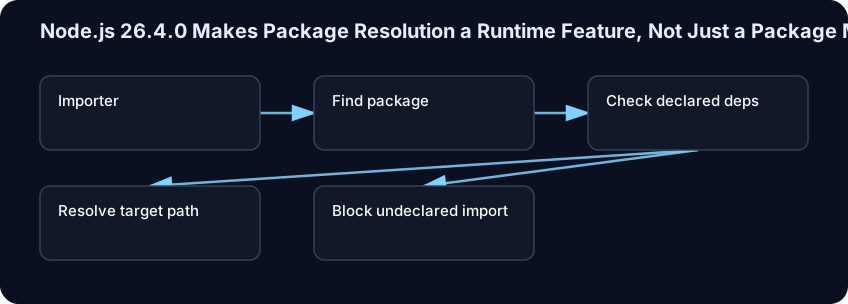
That is the architectural shift here. The runtime can enforce the graph instead of inferring it from whatever directory tree your package manager happened to build.
This release also hints at where Node is going next
The rest of the v26.4.0 notes reinforce the same theme.
The release includes a minimal `node:vfs` subsystem and a follow-up change that dispatches node:fs/promises to mounted VFS instances. I would not build production architecture around that today. It is still early, still experimental, and still clearly being assembled in pieces. But it is another sign that Node is becoming more explicit about resolution, filesystems, and runtime indirection.
There is also a new fs improvement in the same release: support for caller-supplied readFile() buffers. That is not flashy blog material, but it is the kind of API surface that matters when you care about allocations, memory churn, and systems-style Node workloads.
Put differently: this release is not about one headline feature. It is about Node getting more opinionated in places where JavaScript runtimes used to shrug and say, "that is the toolchain's problem."
What I would do with this right now
If you run a small app, probably nothing yet.
If you run a workspace or platform team, I would absolutely start tracking this release line and testing package maps in a sandbox branch.
Focus on these questions:
Can your package manager generate the graph you actually want?
Which current imports only work because of hoisting accidents?
How many internal packages are relying on transitive visibility?
Would stricter runtime resolution catch bugs earlier than your current linting does?
My bet is that a lot of teams will discover they have been using node_modules layout as an accidental policy engine.
That has always been fragile. Node 26.4.0 is interesting because it starts offering a runtime-level alternative.
The real takeaway
I do not think v26.4.0 is memorable because it shipped a giant user-facing feature. I think it is memorable because it quietly moves Node toward a model where the runtime knows more about your dependency graph, your filesystem abstraction, and your intent.
That is a better direction for large JavaScript systems.
Not because it is trendy. Because every serious monorepo eventually learns the same lesson: if your dependency rules only exist as conventions around node_modules, they are not rules. They are vibes.
Sources: `Node.js v26.4.0 release notes`, `loader: implement package maps` PR #62239.