Node.js 26.3.0 Adds `permission.drop()`: Finally, a Runtime Way to Shrink Privileges After Boot
Node.js 26.3.0 introduces `permission.drop()`, which makes the permission model more practical for real services that need broad startup access but tighter runtime access.

Node.js 26.3.0 quietly fixed the most annoying part of the permission model
On June 1, 2026, Node.js shipped 26.3.0. It is a Current release, not LTS, so this is not a "flip it on everywhere by Friday" update. But one change in it is much more important than the release title makes it sound: permission.drop().
That API matters because Node's permission model has had a practical problem for a while. The theory was great: start your process with restricted access to files, child processes, workers, network, and so on. The reality was messier: plenty of real services need wider access during startup than they need once they're actually serving requests.
You load config from disk. You read certs. You warm a cache. You maybe spawn a helper. Then the app is live, and suddenly most of those permissions are just liability.
Before this release, that gap made the permission model feel more like a demo feature than an everyday hardening tool. permission.drop() is the first update that makes me think, "okay, now this can fit an actual service lifecycle."
Why this is the useful kind of security feature
The official release notes list permission.drop among the notable changes in Node.js 26.3.0. That sounds small. It is not.
The practical pattern is straightforward:
Start the process with only the permissions you need for boot.
Finish initialization.
Drop permissions you should not need during request handling.
Keep the hot path running with a smaller blast radius.
That is a much better model than pretending startup and steady-state have identical security needs.
A lot of Node services are built like this already, just informally:
broad access at boot
optimistic assumptions in runtime
hope nobody finds an SSRF, RCE, template injection, or dependency surprise
permission.drop() does not make your app secure by magic. It does give you a clean checkpoint where the process can become less dangerous after boot.
The architecture shift
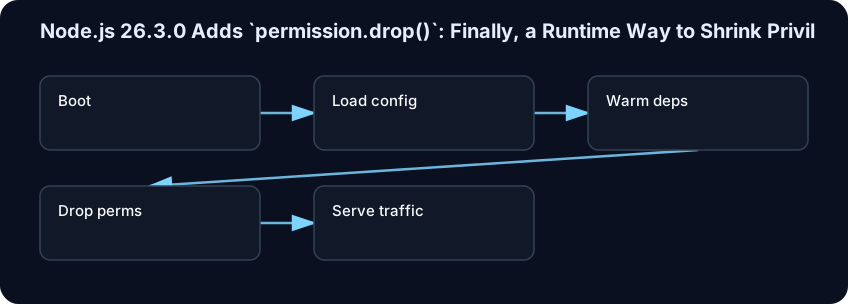
That is the whole idea. Short, boring, and finally realistic.
The pattern I expect good teams to adopt
If you are already experimenting with the permission model on Node 26, the move is not "turn on every restriction and pray." The move is to design two phases.
Phase 1: startup
This phase can read the files it genuinely needs, connect to what it must connect to, and perform one-time setup.
Phase 2: steady-state runtime
This phase should be aggressively boring. Your request handlers usually do not need permission to spawn random processes, write arbitrary files, or access extra directories just because the bootstrap path did.
That leads to code shaped more like this:
import fs from 'node:fs/promises';
import http from 'node:http';

const config = JSON.parse(
  await fs.readFile('/app/config/runtime.json', 'utf8')
);

await warmConnections(config);
await preloadTemplates();

process.permission.drop('fs.write');
process.permission.drop('child');
process.permission.drop('worker');

http.createServer(handler).listen(config.port);
The exact permission names and startup flags depend on your runtime setup, and you should verify them against the current Node 26 docs and behavior in your environment. But the shape is the point: initialize first, then narrow the process.
This is the kind of thing platform teams can standardize.
Web API template drops
childafter boot.Queue worker drops
fs.writeafter local state setup.Edge-ish gateway process drops everything not needed for proxying.
Now the security posture is not just a wiki page. It is executable.
Where this helps immediately
The best use case is not toy scripts. It is long-lived backend processes.
Think about services that do one or more of these during boot:
read local secrets or cert bundles
hydrate allowlists from disk
compile or preload templates
spawn one-time setup helpers
open broader access than the request path should ever need
Those are exactly the apps where a post-boot privilege drop makes sense.
And yes, this is also relevant if you run internal tooling, job runners, or agent-style services. Those processes tend to start life with way too much trust because they are "internal." Internal is not a security boundary. It is just where tomorrow's incident report starts.
The part people will misuse
Some teams will treat permission.drop() like a sticker.
They will add it after boot, mention it in a security review, and never test the failure mode.
That is useless.
If you adopt this, test the negative cases on purpose:
Does your app fail cleanly if code later tries to write to disk?
Did you accidentally leave a background path that still expects worker creation?
Do your health checks or admin endpoints trigger restricted behavior?
Are you sure the permission is dropped before the server starts accepting traffic?
If the answer is "we did not check," then you do not have a hardening control. You have a tweet draft.
Two other changes worth noticing
permission.drop() is the headline for me, but 26.3.0 also shipped a couple of smaller changes that are easy to miss in the release notes.
There is a new httpValidation option for header value validation in HTTP, and the default Buffer.poolSize was increased to 64 KiB in the same release notes for 26.3.0.
Those may matter in specific workloads, but they are not the reason I would spend time evaluating this release. The runtime privilege-drop story is.
One more operational note from the same release: Node explicitly called out a risk that macOS universal binaries may not remain available for the full lifetime of Node 26 as Apple continues moving away from Intel. If your developer fleet still depends on Intel Macs, do not ignore that footnote. It is the kind of release note teams skip until onboarding breaks.
Should you use it now?
If you run production on LTS only, probably not broadly. Node 26.3.0 was released on June 1, 2026, and it is still on the Current line. That means evaluation, not blanket rollout.
But if you own platform standards, service templates, or internal infrastructure libraries, this is exactly the time to prototype the pattern.
add a startup/runtime permission boundary
codify where privilege dropping happens
make tests assert forbidden operations after boot
prepare the pattern now so it is boring by the time Node 26 eventually matures toward wider adoption
That is the real value of this update.
Not "Node added another security API."
Node finally added the piece that makes its permission model fit how real services actually start, then live.
And honestly, that was the missing part.