GitHub Copilot’s June 1 Billing Flip Means Your AI Coding Budget Needs Guardrails
GitHub Copilot switched to token-based AI Credits on June 1, 2026. Here’s what that changes for teams, budgets, and day-to-day developer workflows.

GitHub Copilot is now a metered dependency
On **June 1, 2026**, GitHub flipped Copilot from request-style pricing to **usage-based billing with GitHub AI Credits**. That sounds like a pricing footnote. It is not. It changes how you should run AI coding tools inside a team.
The official announcement is simple: Copilot usage now burns credits based on **token consumption** across input, output, and cached tokens, priced by model, with **1 AI credit = $0.01 USD**. GitHub also says **code completions and Next Edit suggestions do not consume AI Credits**, while **Copilot code review consumes both AI Credits and GitHub Actions minutes**. For orgs, included credits are **pooled**, and admins can enforce **budget controls** at multiple levels.
That combination matters more than the headline price.
The old mental model was: "we bought seats." The new one is: "we bought seats plus a shared meter." If you still govern Copilot like a flat SaaS license, you will learn about your real usage pattern from a billing screen.
What actually changed
GitHub’s billing announcement makes three things explicit.
First, usage is no longer counted as premium request units. It is metered by tokens and model pricing.
Second, there is **no automatic fallback** once usage limits are hit. GitHub says exhaustion is now governed by **available credits and admin budget controls**, not by quietly dropping users onto a cheaper model.
Third, businesses get a pooled model. In GitHub’s org and enterprise billing docs, included credits are shared at the billing-entity level instead of stranded per user. That is good for utilization, but it also means one team’s agent-heavy workflow can eat capacity that another team assumed was available.
Here is the operational shape now:
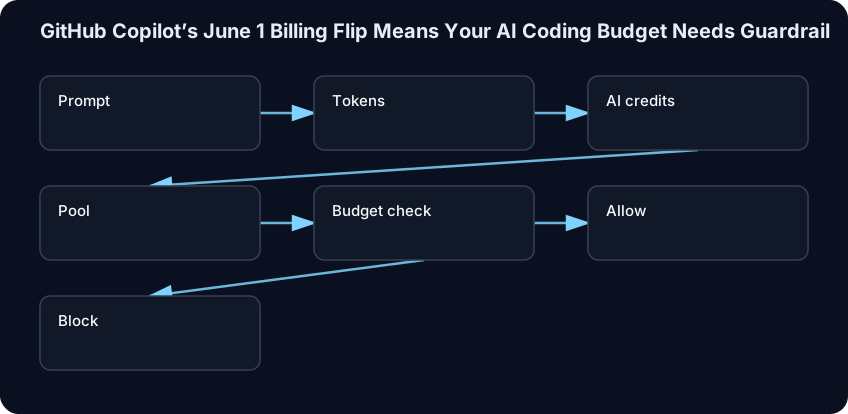
That is not a cosmetic change. That is infrastructure behavior.
The real shift: agent runs now have a visible cost
GitHub’s own rationale is the giveaway. In the announcement, it says Copilot has evolved into an **agentic platform** capable of long, multi-step sessions across repositories, and that a quick question and a multi-hour autonomous session used to cost the same under the old model.
That mismatch is what died on June 1.
If your team is leaning into agentic flows, this is the part to care about. The expensive path is not autocomplete. It is:
large repo context n- repeated retries
long output generations
high-end model selection
background or cloud-agent work that sprawls across multiple steps
That means your cost profile now depends less on "how many developers use Copilot" and more on **how they use it**.
A team of 20 doing quick chat and edits may be cheaper than a team of 5 running long agent sessions against large monorepos.
That is a healthier pricing model, honestly. It is also a model that punishes lazy governance.
What teams should do this week
1. Separate lightweight AI from autonomous AI
Do not treat autocomplete, chat, code review, and agent sessions as one bucket in policy discussions.
GitHub already does not bill them the same way. You should not govern them the same way either.
A practical split looks like this:
Keep completions broadly enabled.
Allow chat by default, but monitor model choice.
Put agentic tasks behind clearer team policies.
Treat automated code review as a CI cost, because it now hits both AI Credits and Actions minutes.
If you mix all of this into one vague "Copilot adoption" metric, you will not know what to fix.
2. Put spending controls where engineering behavior happens
GitHub now supports budgets at user, cost-center, enterprise, and organization-related levels. Use that.
The wrong setup is one giant enterprise pool and vibes.
The better setup is:
Default user budget: low
Platform team budget: higher
Experimental agent projects: isolated cost center
Critical CI review workflows: explicit monthly cap
The point is not to be stingy. The point is to make expensive usage intentional.
3. Stop assuming a fallback model will save you
GitHub explicitly says fallback experiences are going away under the new billing model. That is important.
A lot of teams quietly depended on this behavior without ever documenting it. They thought, "if users run hot, the tool will degrade gracefully." Now the graceful path is whatever budget and blocking rules you configured. If you configured nothing, your production policy is accidental.
4. Treat model choice as an architecture decision
GitHub’s pricing table makes the problem obvious. Different models have materially different token costs, and long-context tiers cost more again.
So stop asking, "Which model is smartest?" Start asking:
Which tasks justify a premium model?
Which flows need long context?
Which workflows can default to lightweight models?
Which jobs should never run unattended?
That is the same kind of question mature teams already ask about database classes, CI runners, and observability cardinality.
AI tools are joining that list.
The subtle trap for platform teams
Pooled credits are good. They prevent stranded capacity. GitHub even gives the example that an enterprise with 100 Copilot Business users gets a shared pool instead of 100 isolated buckets.
But pooled resources always create the same trap: the local user experience feels free until the shared system gets tight.
One aggressive internal workflow can change everyone else’s experience.
That is why this update is really a platform-engineering story, not a pricing story. Someone now needs to own:
budget defaults
model policy
agent usage guidelines
review automation limits
spend visibility by team
If nobody owns that, finance will eventually own it for you, and they will own it badly.
My take
GitHub is right to meter this stuff. A flat seat price for short prompts and long-running agent work was never going to survive. The important part is not the billing mechanic. The important part is that **AI coding assistance is no longer operationally invisible**.
That is the update developers should actually care about this week.
If you run Copilot at team or org scale, the new default stance should be simple: keep the cheap paths wide open, put guardrails around agent-heavy paths, and make model choice deliberate.
Because as of **June 1, 2026**, Copilot is not just a developer perk anymore.
It is a budgeted runtime.