Biome 2.5.3 Fixes the Annoying Framework Edge Cases That Usually Send You Back to ESLint
Biome 2.5.3 is a small release with very practical wins: fewer false positives in Svelte, better Astro and Vue parsing, safer optional chaining checks, and cleaner plugin profiling.

Biome 2.5.3 is a patch release, but it hits the exact stuff that decides whether a tool survives in a real codebase
On July 8, 2026, the Biome team shipped Biome CLI v2.5.3. This is not a headline release. No giant architecture rewrite, no dramatic benchmark chart, no "we replaced three more tools" victory lap.
And honestly, that is why it matters.
Patch releases are where toolchains either become trustworthy or become "looks nice in demos, breaks on Tuesday." Biome 2.5.3 is one of those credibility releases. It fixes parser crashes, closes framework-specific false positives, improves TypeScript-aware diagnostics, and makes plugin profiling less vague. If you are trying to run one formatter/linter stack across mixed frontend repos, this is the kind of release you actually care about.
The big theme: fewer framework tax penalties
Most lint tools look great on plain TypeScript files. The pain starts when your repo stops being plain TypeScript.
You add Svelte. Then Astro. Then a Vue package. Then somebody writes one weird HTML attribute. Then one rule starts missing bracket access, another flags valid template usage, and somebody on the team says, "just disable it for now." That is how rule quality dies.
Biome 2.5.3 spends most of its effort exactly there:
Svelte
noUnusedVariablesfalse positives are fixed for store subscriptions and$bindable()propsAstro shorthand attribute syntax now parses correctly from embedded nodes
Vue
useVueValidVOnno longer complains about valid modifier-only handlers like@click.stopHTML linting/checking no longer crashes on unquoted attribute values
CSS parsing recovers instead of panicking on some unsupported CSS Modules syntax at EOF
That list reads boring, which is usually a good sign. Boring fixes are what make automation dependable.
The Svelte fix is the most immediately useful one
The Svelte change is the one I would bet gets felt fastest in real projects. According to the release notes, Biome no longer flags the underlying store binding as unused when you reference $store in templates, and it also stops complaining about $bindable() props that are intentionally write-only.
That matters because false positives in "unused" rules are uniquely destructive. Teams either stop trusting the rule, or they start cargo-culting suppressions.
This is the exact class of issue that blocks consolidation. You can sell people on replacing ESLint plus Prettier plus plugins only if the replacement understands framework semantics well enough to not gaslight them.
A simplified version of the kind of pattern that used to be risky looks like this:
<script lang="ts">
  import { count } from './stores';
  let { value = $bindable() } = $props();
</script>

<p>{$count}</p>
In tools that do not understand the framework transform layer well enough, count or value can look unused from the script block alone. Humans know better. Your linter should too.
The TypeScript optional chaining fix is more important than it sounds
Biome also tightened noUnsafeOptionalChaining, specifically when optional chains are wrapped in TypeScript syntax like as, satisfies, type assertions, and instantiation expressions. The release notes call out cases like new (value?.constructor as Constructor)().
This is exactly the kind of bug that slips past because the code looks typed and therefore feels safer than it is.
type Constructor = new () => Error;

const err = new (value?.constructor as Constructor)();
That still blows up if value?.constructor resolves to undefined. The type assertion does not make the runtime safe. Biome now reports that pattern correctly, which is what you want from a modern linter: ignore the cosmetic TypeScript wrapping and reason about the actual JavaScript behavior.
If your team leans on TS syntax heavily, this is a meaningful upgrade, not a minor cleanup.
noProcessEnv got a lot less easy to dodge
One of the sneaky fixes in 2.5.3 is that `noProcessEnv` now also catches computed member access. Before this patch, dot access was checked, but bracket access could slip through.
So this:
if (process["env"].NODE_ENV === "production") {
  enableCache();
}
now gets treated like the same smell as this:
if (process.env.NODE_ENV === "production") {
  enableCache();
}
That sounds obvious, but it is exactly the kind of rule gap people accidentally exploit during refactors, codemods, or "quick fixes". If you enable noProcessEnv, you are probably trying to force configuration through a single app boundary. Missing bracket access weakens the whole point.
Plugin profiling finally gets specific enough to use
The sleeper feature here is --profile-rules reporting plugin timings separately as plugin/<pluginName> instead of lumping everything into one generic plugin bucket.
If you are running Biome plugins in CI, this is the difference between:
"plugins are slow"
and "this exact plugin is slow"
That is a real operational improvement.
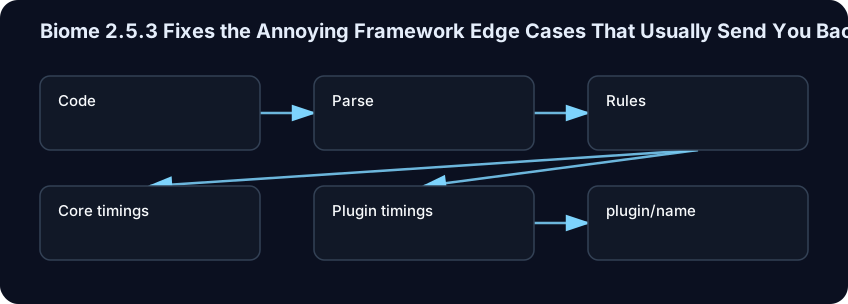
Tooling teams do not need more aggregate charts. They need blame with precision. This update gets closer to that.
Why this release matters more than a flashy major
Biome has been selling a pretty aggressive proposition for a while: one tool, one config surface, one fast Rust core, fewer plugin pyramids. That pitch is compelling, but it only works if the long tail of framework behavior keeps getting handled correctly.
Version 2.5.3 is evidence that the team is doing the boring maintenance needed to make the consolidation story real.
My practical read:
If you already run Biome, upgrade
If you tried it earlier and got burned by framework weirdness, this is the kind of release worth re-testing on your actual repo
If you are still on an ESLint-heavy stack because your app mixes Svelte, Astro, Vue, and plain TS, Biome is getting harder to dismiss on compatibility grounds
This is not the release that makes people tweet. It is the release that makes fewer people open biome.json and start adding exceptions.
That is the better signal anyway.